
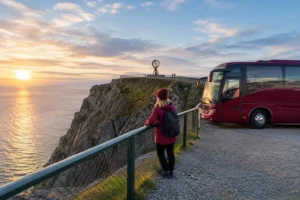
The road to North Cape is part of the experience. From Honningsvåg, the landscape soon becomes open, treeless and wonderfully quiet, with the sea never far from view. If you are wondering how to visit North Cape, the best approach is to plan for more than the destination itself: allow time for the journey, dress for changing weather and choose transport that lets you look out rather than watch the road.
North Cape, known locally as Nordkapp, sits at the northern tip of Magerøya in Finnmark. Standing beside the famous globe monument, with the Barents Sea stretching towards the horizon, is a powerful moment in any season. Yet this is the Arctic, where weather and light shape the day. A little thoughtful planning makes the visit feel calm rather than rushed.
Start in Honningsvåg and allow enough time
Honningsvåg is the natural starting point for most visitors. It is the closest town to North Cape and a regular port of call for cruise ships, as well as a base for independent travellers exploring Magerøya. The drive is relatively short in distance, but it is not a journey to hurry. Road conditions, weather, photo stops and the pace of your group all matter.
For a comfortable visit, set aside several hours from departure to return. This gives you time to enjoy the scenery, spend unhurried time at the plateau and return without worrying about the clock. Cruise guests should pay particular attention to their all-aboard time. Choose an excursion with a clear schedule and a local operator who understands the port routine, local roads and the importance of getting you back on time.
The route itself is memorable. You may pass small fishing communities, wide stretches of tundra and grazing reindeer. In summer, the open light can make the landscape feel almost endless. In winter, the same road can be wrapped in snow and blue twilight. Both are beautiful, but they call for different expectations.
Choose transport that suits the Arctic conditions
Hiring a car offers flexibility, especially for travellers who want to make their own stops. It also brings responsibility. Arctic driving requires confidence in narrow roads, fast-changing weather and winter conditions. If you are unfamiliar with snow, ice, strong winds or limited daylight, a professionally driven transfer can be the more relaxing choice.
A shared coach excursion is often well suited to couples, families and cruise passengers. You can settle into a warm seat, watch the scenery unfold and let an experienced driver manage the route. It is also a sociable option without feeling crowded when the journey is well organised.
Private transport is worth considering for small groups, families with particular needs or travellers looking for more flexibility. A private vehicle can allow for a pace that suits you, whether that means extra time for photographs, a quieter journey or a departure timed around your own plans. Larger groups and travel organisers may need a coach, minibus or local relief driver, particularly when visiting drivers must take their mandatory daily rest.
North Cape Chauffeur Services offers professionally driven journeys from Honningsvåg, including shared excursions and private solutions. The value is not simply getting from one point to another. It is having a local team take care of timing, road awareness and comfort while you take in the view.
How to visit North Cape in summer
Summer at North Cape is defined by light. Around the midnight sun season, roughly from mid-May to late July, the sun can remain above the horizon through the night. The plateau is especially atmospheric late in the evening, when the crowds may thin and the golden light falls across the cliffs and sea.
A late departure is not necessarily a late night by Arctic standards. During the midnight sun period, the bright sky can make it easy to lose track of time. Bring an extra layer even if the day has been mild. The wind at the plateau can be sharp, and the temperature often feels cooler beside the sea.
Summer weather remains changeable. Low cloud can roll in quickly, and a clear horizon is never guaranteed. Do not judge the whole trip by the forecast in town. Conditions at North Cape can differ from Honningsvåg, sometimes dramatically. If the clouds come in, the visit still has its own character: mist, sea birds and the sound of wind against the cliff edge can make the place feel even more remote.
Visiting North Cape in winter and shoulder seasons
Winter travel offers a very different Arctic mood. Snow-covered landscapes, polar night colours and the possibility of northern lights make the journey special, but flexibility becomes essential. Roads may be affected by snowfall, wind and ice, and access to the plateau can sometimes be regulated or temporarily restricted for safety.
The sensible rule is simple: never build a tightly timed winter plan around conditions you cannot control. Check the latest local road and weather information close to departure, and travel with a provider experienced in the region. A scheduled tour may be adjusted if conditions require it. That is not a disappointment or poor planning. It is how safe Arctic travel works.
Northern lights are visible during the darker months, generally from late autumn into early spring, but they can never be promised. You need darkness, suitable solar activity and clear enough skies. North Cape can be a striking place to experience the night sky, yet the journey should be enjoyable whether the aurora appears or not.
Dress for the plateau, not just the forecast
Even on a short visit, clothing makes a real difference. North Cape is exposed, and the wind can turn a pleasant temperature into a cold one very quickly. Think layers rather than one heavy item: a warm base layer, insulating middle layer and windproof outer layer give you the most flexibility.
Wear sturdy shoes with good grip. In winter, insulated footwear and traction aids can be useful, while gloves, a hat and a scarf are sensible throughout much of the year. Keep your phone and camera close to your body in very cold weather, as batteries lose power faster in low temperatures.
A small day bag is enough for most visitors. Carry water, any medication you need and a charged power bank. If you are travelling with children, bring one more warm layer than you think necessary. Standing outside to admire the view feels very different from sitting in a heated vehicle.
Make time for the North Cape plateau
The globe monument is the image most visitors come to see, but do not make it your only stop. Walk carefully around the plateau, pause at the edge of the vast sea view and notice the scale of the cliffs. On a clear day, the horizon seems to go on forever. In fog or snow, the stillness can be just as moving.
There is a visitor centre at North Cape with indoor facilities, exhibitions, refreshments and shelter from the weather. Opening arrangements and admission conditions can vary with the season, so check current details before your trip. It is wise to use the facilities before returning to Honningsvåg, particularly if you are travelling with children or have a longer onward journey.
Photography is best treated patiently. The weather may change several times during your visit, and the most memorable image is not always the standard photograph beside the globe. Look for the curve of the coast, distant islands, reindeer beside the road or the quiet faces of your travelling companions taking it all in.
A few practical booking decisions
Book ahead if you are visiting during a cruise call, in the busy summer period or with a group. This gives you confidence about your seat and departure time, rather than leaving a once-in-a-lifetime outing to chance. When comparing options, look beyond the advertised journey length. Ask where the pickup point is, how much time is planned at North Cape, what happens if weather changes and whether return timing suits your ship or accommodation.
If you need accessibility support, child seating, room for luggage or a private arrangement, raise it when booking. Good local operators can often help when they know what you need in advance. For groups, share your timetable early, especially where mandatory driver rest rules affect the plan.
The finest way to experience North Cape is to arrive with enough time to breathe. Let the road slow you down, step into the crisp Arctic air and give the horizon a few quiet minutes before you turn back south.