
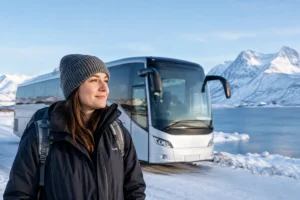
A road to the North Cape can look perfectly clear when you leave Honningsvåg, then change character as wind lifts snow across the plateau or visibility softens around the next bend. That is why choosing safe Arctic coach travel is about more than finding a seat at the right time. It is about placing the journey in the hands of people who understand these roads, respect the weather and know that arriving calmly matters as much as arriving on schedule.
For many visitors, especially those travelling from a cruise ship or with a short stay in the region, the North Cape is a long-awaited moment. The right coach journey should remove uncertainty from the day, leaving room for the crisp Arctic air, the wide horizon and the stillness that makes this part of Norway so memorable.
What safe Arctic coach travel looks like
Safety in the Arctic is rarely one dramatic decision. It is a series of quiet, professional choices made before departure and throughout the drive. A responsible operator prepares vehicles for local conditions, employs trained drivers, monitors the forecast and adapts to what the road requires.
This may mean a smooth, unhurried journey under a clear sky. On another day, it may mean adjusting the pace, following winter traffic arrangements or changing plans when conditions make that necessary. A trustworthy company does not treat these decisions as an inconvenience. It treats them as part of looking after its guests.
The most reassuring sign is not a promise that weather will never affect your plans. Arctic weather can be changeable, and no one can honestly guarantee a particular view or road condition. The better promise is that sound judgement will come first, with clear communication when circumstances change.
Local road knowledge is not an optional extra
The route between Honningsvåg and the North Cape crosses exposed Arctic terrain. It is beautiful in every season, but it deserves respect. Drivers who work locally understand where conditions can shift first, how wind and snow affect the road, and when a calm driving style matters most.
They also understand the rhythm of the destination. That includes how long the route normally takes, where delays may occur, and how to plan time at the North Cape without making the journey feel rushed. This knowledge is particularly valuable for cruise guests, whose return to port is not flexible.
A coach transfer led by an experienced local driver turns unfamiliar terrain into a journey you can simply enjoy. Instead of watching the road, checking maps or wondering whether you have allowed enough time, you can look out at the snow-covered landscape and listen to the guidance offered along the way.
How to assess a coach operator before you book
A polished website and an attractive price can be useful starting points, but they do not tell the whole story. When comparing journeys, look for practical evidence that the company is equipped to operate responsibly in the North Cape region.
First, consider whether the operator speaks clearly about professional drivers, local operation and safety. Vague claims about adventure or speed are less helpful than straightforward information about who is driving and how the service handles changing conditions.
Next, look at the quality of the booking information. You should be able to understand where the coach departs, when you should arrive, how long the experience is expected to take and what happens if the weather affects the route. Clear details are a sign of an organised service, and they make it easier for you to plan the rest of your day.
It is also worth considering the operator’s roots in the area. A company with a long local history has built its reputation through many seasons, not just through photographs taken on perfect days. North Cape Chauffeur Services, the region’s oldest bus company, has seen how quickly the Arctic can change and approaches every journey with that understanding.
Comfort supports safety too
Comfort may seem separate from safety, but on an Arctic day the two are closely connected. A warm, well-maintained coach gives you a sheltered place to settle before and after time outside. Proper seating, space for your belongings and a professional, welcoming atmosphere help everyone travel more comfortably.
For families, comfort can make the difference between a tiring transfer and a shared experience. For couples and solo travellers, it creates space to enjoy the view without the strain of driving on unfamiliar winter roads. You arrive with more energy for the destination itself.
Ask yourself whether the journey has been designed as a complete guest experience or merely as transport from A to B. A good coach service considers the whole day: a straightforward meeting point, a reliable departure, time to take in the scenery and a clear return plan.
The trade-off between independence and reassurance
Hiring a car can offer flexibility, particularly in mild weather and when you are comfortable with winter driving. It may suit travellers who have plenty of time, know the region well or would like to stop independently along the route. Yet flexibility also brings responsibility: road conditions, parking, navigation, fuel, timing and the pressure of getting back to a ship or onward connection.
For many visitors, a scheduled coach is the more restful choice. You still see the landscape unfold, but without being responsible for the next stretch of road. The driver is free to focus on conditions, while you are free to absorb the scale of the place.
The same principle applies when choosing between the cheapest available ticket and a service with a stronger local operating record. A lower fare can be attractive, but it may not include the same level of planning, vehicle comfort, communication or destination knowledge. On a once-in-a-lifetime visit, value is often found in the confidence that your day is being handled well.
Questions worth asking before departure
Before you reserve, make sure the operator can answer a few simple questions clearly. Confirm the departure point and the time you need to be there. If you are arriving by cruise ship, check that the service is planned around the ship’s schedule and allows an appropriate return margin.
Ask how weather-related updates are communicated and what the usual approach is if road conditions become difficult. You do not need a technical explanation of every winter procedure. You need to know that there is a sensible process, that the driver has authority to make safe decisions and that you will not be left guessing.
It is sensible to check what is included in the duration of the tour as well. Time at the North Cape matters. A well-planned journey gives you the chance to step outside, feel the wind from the Barents Sea, take your photographs and enjoy the visitor facilities without constantly checking the clock.
Finally, dress for being outdoors even if the coach itself is warm. Layers, insulated footwear, gloves and a hat are useful in every season, as coastal weather can feel colder than expected. Your driver and guide can help with practical advice, but personal preparation lets you enjoy the moment for longer.
Let the journey set the tone for your visit
The road north is not simply the gap between your accommodation or ship and a famous globe at the edge of Europe. It is part of the North Cape experience: a changing canvas of rock, sea, snow and open sky. When you travel with a safety-minded local operator, there is no need to hurry past it.
Choose the service that is candid about Arctic conditions, confident without being careless, and attentive to the time you have ashore. Then settle into your seat, let the landscape widen beyond the window, and save your attention for the horizon waiting ahead.