
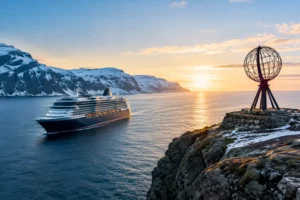
A cruise ship can bring you remarkably close to the top of Europe, but the final stretch is part of the experience. Can cruises reach North Cape? Yes, in practical terms, they can: most cruise guests arrive in Honningsvåg, then travel by road to the North Cape plateau. The journey takes you from a welcoming harbour town through open Arctic landscape to the edge of the continent, where the sea seems to continue forever.
What a cruise cannot usually do is berth directly beneath the North Cape cliff. The plateau sits high above the Barents Sea, around 34 kilometres from Honningsvåg. A well-planned shore transfer is therefore the key to reaching it comfortably, allowing enough time to enjoy the scenery along the way and the stillness at the destination.
Can cruises reach North Cape directly?
Cruise itineraries often describe a call at “North Cape”, but the port of call is normally Honningsvåg. This small town on Magerøya is the natural gateway to the plateau and is equipped to welcome visiting ships. From the harbour, the road rises towards the cape through a landscape shaped by wind, sea and long Arctic winters.
A few smaller expedition vessels may operate differently, and ships can occasionally cruise near the coastline when conditions allow. However, North Cape is not a conventional cruise terminal. For most travellers, the proper visit begins after leaving the ship, with a road journey arranged as a ship excursion, a private tour or a scheduled coach transfer.
This is worth knowing before you book. It sets the right expectation: your North Cape experience is not simply a quick stop at a pier. It is a journey with a destination at its heart.
From Honningsvåg harbour to the North Cape plateau
The drive from Honningsvåg to North Cape is relatively short, yet it feels far removed from everyday travel. The route crosses Magerøya, where treeless hills meet the sea and changing light can make the landscape feel different from one bend in the road to the next. In summer, the midnight sun may cast a soft glow across the horizon. In winter, snow and low Arctic light give the journey a quieter, more dramatic character.
For cruise passengers, a coach transfer is often the simplest choice. You are collected close to the ship, travel with a professional local driver and return to Honningsvåg in time for departure. There is no need to understand unfamiliar road conditions, find parking at the plateau or calculate every turn against the ship’s sailing schedule.
The road is maintained throughout the year, but this is the Arctic. Weather can change quickly, particularly outside summer. Strong winds, snowfall, fog or icy conditions may affect how the journey is operated. A local transport provider monitors conditions and adjusts with safety in mind, which is one reason guided travel brings real reassurance here.
Why timing matters on a cruise call
Your available time ashore depends on the ship’s schedule. Some vessels stay for several hours, while others have a shorter port call. The actual driving time is only one part of the plan. You also need time to disembark, meet your transport, enjoy the plateau, return through the landscape and be back at the ship well before all-aboard.
When booking independently, check your arrival and departure times carefully. Choose a departure designed around cruise calls, rather than one that leaves little room for delays. A responsible operator will make the meeting arrangements clear and build the experience around the realities of the harbour and sailing timetable.
For visitors who prefer not to rush, the best transfer is one that gives you time to stand outside, breathe the crisp Arctic air and take in the endless horizon without watching the clock every minute.
What to expect when you arrive
North Cape is a plateau rather than a village or a single viewpoint. At roughly 307 metres above the sea, it is known for its monumental globe sculpture and its position facing the vast Barents Sea. On a clear day, the view has a remarkable sense of distance. On a misty day, the atmosphere can be just as memorable – the cliff, cloud and sea create a powerful feeling of being at the edge of the known world.
There is a visitor centre with facilities, exhibitions and indoor space to warm up, as well as outdoor areas where you can experience the cape itself. Entry arrangements may be included with certain tours or handled separately, so it is sensible to confirm what your chosen excursion covers before travelling.
The weather deserves respect. Even in summer, temperatures can be cool and wind on the plateau can be sharp. Bring warm layers, a windproof outer layer and sturdy shoes with good grip. In winter, warm insulated clothing is essential. You do not need specialist expedition equipment for a guided visit, but you will be far more comfortable if you dress for exposed conditions rather than the temperature at the harbour.
Ship excursion or independent transfer?
Both options can work well, and the right one depends on the kind of day you want.
A ship-organised excursion offers the comfort of travelling within the cruise line’s programme. It can be especially appealing if you want every element handled through your ship. The trade-off is that group sizes and timings may be less flexible, and the coach journey may feel more like a standard shore call.
An independent guided transfer can offer a more personal pace and a closer connection to the place you have come so far to see. You may travel with a smaller group or on a scheduled local coach, with drivers who know the roads, weather patterns and rhythm of Honningsvåg. North Cape Chauffeur Services, for example, operates transfers from Honningsvåg with the journey itself treated as a meaningful part of the day, not merely the distance between ship and viewpoint.
Whichever option you choose, book ahead when your cruise date is confirmed. North Cape is one of Norway’s most sought-after Arctic destinations, and availability can be limited when several ships are in port.
Questions to ask before reserving
Before committing to a transfer, ask whether it is suitable for your ship’s schedule, where the meeting point is, how long you will have at North Cape and whether admission is included. It is also useful to ask what happens if conditions change. Clear, calm answers are a good sign that your day is being planned with care.
If mobility is a consideration, check the walking involved at the plateau. The main areas are accessible for many visitors, but surfaces can be uneven or slippery in poor weather. A provider who understands your needs in advance can help you choose the most comfortable option.
Is North Cape worth leaving the ship for?
For many guests, this is the defining moment of a northern Norway cruise. Honningsvåg has its own charm, but North Cape offers something different: a sense of scale that photographs only partly convey. You arrive not just at a famous landmark, but at a place where land, weather and ocean meet with very little between you and the northern horizon.
It is not a guarantee of perfect sunshine or a postcard-blue sea. Arctic travel is more honest than that. Clouds may gather, wind may rise and visibility may shift within minutes. Yet those changing conditions are part of what makes the cape feel real. A guided journey helps you meet them with confidence rather than concern.
When your ship arrives in Honningsvåg, leave enough room in the day for the road, the weather and a few quiet minutes at the cliff edge. The North Cape is at its best when you allow yourself to arrive fully.