
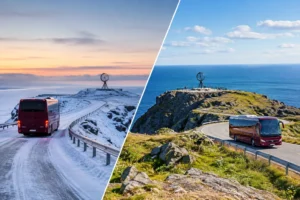
The difference between winter versus summer road access is not simply a question of temperature. On the journey from Honningsvåg towards North Cape, the road becomes part of the experience: sometimes open beneath a low midnight sun, sometimes shaped by snow, wind and Arctic darkness. Knowing what each season asks of you makes it easier to choose a journey that feels calm rather than uncertain.
For many visitors, the best choice is not about being adventurous. It is about having the right expectations, allowing enough time and travelling with people who understand local conditions.
Winter versus summer road access at North Cape
The road to North Cape is a public road, but the final approach is exposed to the weather that defines this northern coastline. Conditions can change quickly at any time of year. In winter, snow, drifting and strong winds may affect access. In summer, the road is usually more straightforward, yet fog, rain and wind can still arrive without much warning.
The practical difference is significant. Summer travel generally offers normal road access, clear views when the weather permits, and long daylight hours. Winter travel can involve controlled driving behind a snowplough convoy when conditions require it, or temporary closures when safe passage cannot be assured.
Neither season is automatically better. They offer two very different versions of the same remarkable destination.
Summer: more daylight, more freedom to look around
From late spring through early autumn, travellers often find the road journey easier to picture. The landscape is open, the route is usually clear of snow, and daylight stretches far into the evening. During the midnight sun period, there is no need to rush back before darkness. The sky remains bright, the sea catches the changing light, and the horizon seems to continue without end.
This makes summer especially appealing for cruise guests with a limited port call, families who prefer predictable logistics, and independent travellers who want to enjoy the scenery without worrying about winter driving conditions. It is also a popular period, so departures and private transport should be arranged early where possible.
A clear road does not mean an uneventful one. Magerøya is exposed country, and summer weather can be cool even on a bright day. Wind may be sharp at the plateau, while fog can briefly soften views that were wide open only moments before. A warm outer layer and sensible footwear remain useful, even in July.
The advantage of a professionally driven journey is simple: you can look out rather than watch the road. You have time to notice the reindeer grazing near the roadside, the small fishing communities, the treeless coastal landscape and the endless Arctic light.
Winter: a quieter journey shaped by the elements
Winter access carries a different kind of beauty. Snow settles across the island, the daylight is low and blue, and the landscape often feels almost completely still. If the sky is clear after dark, this is also the season when the northern lights may appear. It is a powerful setting, but it deserves a measured approach.
At certain times and in certain conditions, access to the North Cape plateau may be organised as a convoy behind a snowplough. This is a safety measure, not an attraction or a guarantee. Departure times, waiting periods and the decision to run are determined by road and weather conditions. If the weather becomes too severe, the road may close temporarily.
This is why fixed independent plans can be difficult in winter. Hiring a car can be suitable for confident drivers with appropriate experience, but unfamiliar visitors should not underestimate changing visibility, icy surfaces, high winds and the limited daylight around the polar night period. Local knowledge is valuable precisely because it respects the conditions rather than trying to outpace them.
A scheduled or private transfer removes much of the pressure. Your driver monitors the route, adapts to the conditions and handles the practical decisions, while you travel in warmth and comfort. North Cape Chauffeur Services plans journeys with safety and realistic timing at the centre, so passengers can enjoy the crisp Arctic air and winter scenery without carrying the responsibility of the road.
What road conditions can change on the day
Weather forecasts are useful, but they are not the full story on an exposed Arctic route. A forecast for light snow may be manageable in one place and more difficult where wind lifts snow across the road. Visibility, wind direction, recent snowfall and road treatment all matter.
In winter, allow room in your plans for delays. Do not schedule a tight connection immediately after a North Cape excursion if you can avoid it. Cruise passengers should choose a transfer designed around their ship’s time in port, with a clear meeting arrangement and a sensible return margin. Tour operators and group organisers should build flexibility into their itineraries, especially for evening programmes.
Summer requires less contingency, but timing still matters. A ship arriving late, a busy visitor period, or a change in weather can all affect the rhythm of the day. The most comfortable journeys leave enough time to enjoy the destination rather than treating every minute as a race.
Visibility is part of the experience
Many people imagine North Cape as a single postcard view: the globe monument above a dramatic cliff and the Barents Sea beyond it. On a clear day, that view can be unforgettable. Yet Arctic weather has its own character. Fog may obscure the horizon, cloud may sit low over the plateau, or snow may transform familiar landmarks into a softer, quieter scene.
This does not mean the visit has failed. It means the North Cape is being itself. The value of travelling with a local host is not a promise of perfect weather. It is the reassurance that the journey is thoughtfully managed and that there is still meaning in the changing light, the coastal road and the stillness of nature.
Choosing the right season for your group
Summer is often the natural choice if you want easier road conditions, maximum daylight and the chance to experience the midnight sun. It suits first-time Arctic visitors, multigenerational families and groups working to a firm cruise timetable. The scenery is expansive, and the journey feels relaxed when travel is arranged in advance.
Winter may be right for travellers drawn to snow-covered landscapes, polar night light and the possibility of northern lights. It is also well suited to those who value a quieter atmosphere and are comfortable with the fact that nature sets the pace. Winter rewards patience, warm clothing and a flexible mindset.
For visiting coach companies, the season also affects duty planning. A late-night excursion under the midnight sun or a winter journey requiring extra care can extend a working day. Experienced local relief drivers can take over the visiting coach while the regular driver completes mandatory daily rest. Alternatively, a local vehicle and chauffeur can be arranged to suit the group size. This protects both legal compliance and the quality of the passenger experience.
How to travel comfortably in either season
The simplest preparation is to dress for being outside at the plateau, not just for the temperature in town. In winter, choose insulated layers, a windproof outer jacket, gloves, a hat and footwear with good grip. In summer, bring a warm layer and waterproof protection, as coastal wind can make even mild temperatures feel cooler.
Keep your schedule realistic. The road journey should be something you enjoy, not merely the distance between two points. A comfortable coach or private vehicle gives you a warm place to settle in, room for your belongings and the freedom to watch the landscape change outside the window.
If you are travelling independently, confirm your departure details, meeting point and return time before setting out. If you are organising a group, share practical clothing guidance and explain that access decisions are always made with safety first. Clear expectations help everyone arrive more relaxed.
The North Cape does not need perfect weather to leave an impression. Whether you meet it under the midnight sun or through the hush of a snowy winter day, give the journey enough time, travel with care, and let the Arctic set its own pace.