
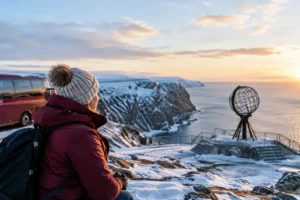
The road towards North Cape can look perfectly clear one moment and feel entirely different the next. Low winter light, wind sweeping across open ground and fast-changing weather are part of the experience, not a reason to miss it. The best safe Arctic travel tips begin with a simple mindset: leave room in your plans, dress for the conditions and let local knowledge guide the journey.
For visitors arriving in Honningsvåg, especially on a cruise timetable, the journey itself is often as memorable as the destination. A calm, well-prepared approach means you can notice the snow-covered hills, crisp Arctic air and wide, quiet horizon rather than worrying about every practical detail.
Plan around Arctic conditions, not a fixed picture
Arctic weather does not follow a holiday itinerary. A bright morning can give way to wind, snow or mist by the afternoon, while a grey sky can open suddenly to an extraordinary view. Conditions are particularly variable between late autumn and early spring, but wind and fog can also affect summer travel on Magerøya.
Build flexibility into your day wherever possible. If you are visiting from a cruise ship, choose an excursion or transfer designed around the ship’s schedule and allow sensible time to return to the harbour. Independent travellers should avoid arranging tight connections immediately after a North Cape visit. A little breathing space turns an unexpected weather delay into part of the day rather than a source of stress.
Road access may be managed or temporarily restricted when conditions demand it. This is a normal safety measure in Finnmark, not a failure of the journey. Listen to local advice, follow official instructions and avoid assuming that a satnav estimate reflects the reality of an Arctic road.
Choose transport that matches the day
Driving yourself can offer freedom, but it also asks more of you than driving in milder climates. Winter roads may involve ice, snow, reduced visibility and strong crosswinds. If you are not used to these conditions, or if you have limited time ashore, travelling with an experienced local driver is often the more comfortable choice.
A professional driver reads the road, monitors conditions and understands where the exposed stretches are. You are free to watch the landscape, take photographs when it is safe to stop and arrive without the fatigue of concentrating on unfamiliar winter driving. This is particularly valuable for families, couples travelling in the darker months and guests who want the North Cape experience to feel unhurried.
For organised groups, transport planning should include the driver as carefully as the passengers. Coach operators must respect mandatory daily rest rules. A qualified local relief driver can take over the visiting coach for a North Cape excursion, including late-evening midnight sun departures, so passengers can continue their plans while the regular driver rests properly. Depending on the group, a local driver and suitable coach, minibus or taxi may be the better arrangement.
Dress for standing still, not just getting there
The temperature on a weather app is only part of the story. Wind can make a short walk outside feel far colder, especially at the North Cape plateau where there is little shelter. Dress in layers that trap warmth and allow you to adjust comfortably once you are inside a heated vehicle.
Start with a warm base layer, add an insulating middle layer and finish with a windproof, waterproof outer layer. A hat that covers your ears, insulated gloves, a neck warmer and warm socks make a real difference. Choose sturdy footwear with a good grip. Fashion trainers may be fine for a city pavement, but they are not ideal on compacted snow, ice or uneven ground.
Bring these five items even for a short excursion:
- A warm hat and gloves, ideally with a spare pair if snow is expected.
- Waterproof outer layers that block wind as well as moisture.
- Insulated footwear with a secure sole.
- A charged mobile phone and a portable power bank, as cold temperatures reduce battery life.
- Water and a small snack, particularly if you are travelling with children or have dietary needs.
Do not overdress to the point of becoming damp with perspiration. If you are active, open a layer or remove a hat briefly, then cover up again before you feel chilled. Staying dry is one of the simplest ways to stay warm.
Safe Arctic travel tips for photographs and viewpoints
The Arctic rewards patience. The most dramatic photograph is not worth stepping beyond a marked area, climbing on icy edges or turning your back on the weather. Keep a firm footing, stay aware of your surroundings and give children clear boundaries before everyone becomes absorbed in the view.
Cold hands make it easy to drop a mobile phone or camera, so use a wrist strap where possible. Keep equipment inside your coat or bag between shots to protect the battery. If you are hoping to photograph the northern lights, practise your camera settings indoors before leaving. At night, your first priority is safe footing and staying together, not perfect exposure settings.
Respect the stillness of nature as well. Keep noise low, take your litter with you and do not approach wildlife. Arctic landscapes can appear vast and empty, yet they are sensitive places shaped by weather, seasons and the animals that live there.
Give darkness the respect it deserves
From late autumn to early spring, darkness is part of daily life in Northern Norway. It can be beautiful, with blue twilight, snow reflecting light and the possibility of aurora overhead. It also changes how distances, ice and roadside edges appear.
Carry a small torch or head torch if you expect to walk outdoors after dark. Use reflective details on clothing or a bag if you are near traffic, and avoid wandering away from established meeting points. In a group, agree where and when you will regroup before anyone heads out to take photographs.
The northern lights are never guaranteed. They depend on solar activity and clear enough skies, and even a strong forecast cannot promise a show at a particular minute. Treat an aurora outing as time spent under an Arctic sky rather than a performance with a fixed start time. You will enjoy the evening more, whether the lights appear as a faint green ribbon or remain hidden behind cloud.
Keep your schedule calm and your expectations realistic
A North Cape visit is not improved by racing through it. Allow time for warm-up stops, changing conditions, toilets and simply looking out of the window. Cruise guests should carry the details of their ship, all-aboard time and excursion contact information. Independent travellers should keep accommodation and transport details readily available, including a local contact number saved on their mobile phone.
If you have reduced mobility, are travelling with a pram or need help with luggage, ask about access and vehicle suitability before booking. The right solution may be a coach with a planned stop, a smaller vehicle with closer set-down access or a private arrangement that moves at your pace. Clear information in advance is far more useful than trying to adapt at the roadside.
There is also a balance between comfort and spontaneity. Pre-booked transport offers reassurance during busy cruise calls and winter conditions, while free time at the destination leaves room for an unexpected break in the cloud or a quiet moment by the endless horizon. Choose the balance that suits your group, rather than trying to fit every possible sight into one day.
Let local experience carry the practical details
A trusted local operator does more than provide a seat. They understand the roads, the rhythms of arrivals and departures, and the difference between a minor change in weather and a condition that calls for a different plan. With North Cape Chauffeur Services, that local care is built into the journey, from a straightforward reservation to a professionally driven ride through the Arctic landscape.
The North Cape will always belong to the weather, the light and the season. Arrive prepared, leave time to breathe, and let the road be part of the memory.