
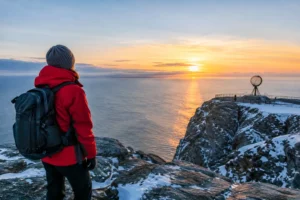
The road from Honningsvåg towards North Cape is not simply a route to tick off. It is part of the experience: open coast, low Arctic light, snow resting on the plateau in winter, and a horizon that seems to make time slow down. Arctic tourism is at its best when there is room to notice these details, while knowing that the practical side of the journey is in safe hands.
For many visitors, this is a once-in-a-lifetime day. Cruise passengers may have only a few hours ashore. Independent travellers may be unfamiliar with winter roads and fast-changing weather. A good North Cape visit should feel calm rather than rushed, with enough structure to make the freedom of the landscape enjoyable.
What Makes Arctic Tourism Different Here?
The Arctic is not a theme park, and that is its strength. Conditions shape each day. A bright, still morning can give way to cloud, wind or snow, while a moody sky can make the cliffs and sea feel even more memorable. Travelling here well means arriving with curiosity rather than a fixed script.
North Cape sits on Magerøya, far above the Barents Sea. The famous globe monument is a powerful reason to come, but it is not the only one. The experience also lies in the exposed coastal scenery, the feeling of standing at the edge of Europe, and the quiet between the busier moments. Even when other visitors are present, the landscape has a way of restoring perspective.
This is why the journey deserves as much thought as the destination. Self-driving can suit confident travellers in favourable conditions, especially those with time to adapt their plans. Yet it brings responsibilities: winter-driving experience, road updates, parking, fuel planning and the need to remain focused when the scenery is asking for your attention. For many guests, a professionally driven transfer is the more restful choice.
Choose the Season for the Experience You Want
There is no single best season for North Cape. There is only the season that best fits the kind of Arctic day you hope to have.
Winter: stillness, snow and polar night
From late autumn into early spring, the region can feel wonderfully elemental. Snow-covered ground, crisp air and long blue hours create a distinctly northern atmosphere. During the polar night period, the sun does not rise above the horizon, but daylight often arrives as a soft, luminous twilight.
Winter travel requires patience. Weather can affect road conditions and visibility, and plans sometimes need to follow safety advice rather than a timetable alone. That flexibility is not a compromise on the Arctic experience. It is part of respecting the place. Warm layers, insulated footwear, gloves and a hat are essential, even for short periods outside.
Spring and autumn: changing light and fewer crowds
The shoulder seasons often reward travellers who enjoy contrast. Spring brings lengthening days and lingering snow, while autumn can offer clear air, deeper colours and a quieter pace. These months can be ideal for visitors who prefer cooler weather without seeking the full intensity of midwinter.
Conditions remain variable, particularly in early spring and late autumn. Bring layers that can be added or removed easily, and do not assume that a mild morning in Honningsvåg means the plateau will feel the same.
Summer: midnight sun and wide-open views
Summer reveals another side of Arctic tourism. Under the midnight sun, the day seems to stretch beyond its usual boundaries. The green of the island, the birdlife along the coast and the bright sea make the drive feel expansive and generous.
This is also the busiest period, particularly when cruise ships are in port. Booking transport ahead is wise if your time ashore is limited. A planned departure removes the uncertainty of finding a seat at the last minute and helps protect precious time at North Cape itself.
Plan Around Time, Not Just Distance
On a map, the journey from Honningsvåg to North Cape may look straightforward. In practice, time depends on weather, road conditions, traffic and how long you wish to spend at the destination. It is better to leave a little margin than to turn a special outing into a race against the clock.
Cruise guests should allow for the walk between ship and meeting point, the possibility of port-side congestion, and the time needed to return comfortably before all-aboard. Independent travellers benefit from the same principle. Build the day around a reliable departure and return, then enjoy the scenery without repeatedly checking the time.
A guided coach transfer makes this easier. You can look out of the window, take photographs when it is safe to stop, and hear local context without having to manage the road. North Cape Chauffeur Services has operated in the region for generations, and that local familiarity matters when conditions call for sound judgement rather than haste.
Travel Comfortably in Arctic Conditions
The most useful packing advice is simple: prepare for wind. Arctic temperatures can be manageable with the right clothing, but wind makes exposed viewpoints feel much colder than expected. Think in layers: a warm base layer, an insulating middle layer and a windproof outer layer. A scarf or neck warmer is particularly helpful near the cliffs.
Footwear should be warm, stable and suitable for uneven or snowy ground. Sunglasses can also be useful, even in winter, when low sun reflects sharply from snow and sea. Keep your mobile phone and camera close to your body in very cold weather, as batteries can lose charge more quickly.
Comfort is more than clothing. It is also about choosing a journey that allows you to rest, warm up and take in the views. On a modern coach, the landscape becomes part of the day rather than something seen only through a windscreen between driving tasks. This matters for families, couples and solo travellers alike.
Respect the Place That Welcomes You
Arctic tourism brings livelihoods and visitors to remote communities, but the landscape is not limitless. Small choices help protect what people come to see. Stay on marked paths where they are provided, take all litter with you, and give wildlife plenty of space. If weather closes in, avoid going beyond safe areas simply to get a photograph.
Respect also means being considerate of local life. Honningsvåg is a working town, and the roads are used by residents, service vehicles and people going about their daily routines. Patience and courtesy make a difference, especially on busy cruise days.
Photography is part of the joy of North Cape, but it need not take over the visit. Take the picture, then lower the camera for a moment. Listen to the wind. Notice the scale of the sea. The strongest memory is often the one that was never posted.
Let the Journey Have Its Own Value
The North Cape globe may be the landmark you remember, but the route there often becomes the story you tell later: a line of reindeer in the distance, a sudden break in the cloud, the colour of the light over the water, or the quiet relief of arriving warm and unhurried.
That is the lasting appeal of Arctic tourism in this corner of Norway. It asks very little beyond practical preparation and an open mind. Give yourself enough time, choose transport that lets you relax, and let the weather set the tone. At North Cape, the landscape does not need to perform. It only needs to be met with attention.