
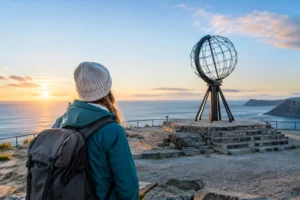
The road from Honningsvåg to the North Cape is not simply the route to a famous landmark. It is part of the experience: open tundra, low Arctic light, distant coastline and the quiet sense of travelling towards the edge of Europe. A North Cape Norway day trip gives you time to take it in without turning the journey into a race against unfamiliar roads, changing weather or the clock.
For many visitors, especially those arriving by cruise ship, the North Cape is the one place they most hope to see. With a little thoughtful planning, it can feel wonderfully straightforward. The key is to allow enough time for the road, choose transport that suits the conditions and leave room to stand at the plateau without constantly checking your watch.
What makes the journey to North Cape special
North Cape lies on Magerøya, an island connected to the mainland by the North Cape Tunnel. From Honningsvåg, the journey passes through a landscape that becomes steadily more open and elemental. In summer, the ground may be covered in soft green and gold, with reindeer grazing close to the road. In colder months, snow can transform the scene into a bright, still expanse.
The destination is known for its dramatic cliff edge and far-reaching view across the Barents Sea. At 71°10’21” north, you are standing in a place that feels genuinely remote, yet is accessible with the right preparation. The sensation is not about ticking off a geographical point. It is about crisp Arctic air, the endless horizon and the rare opportunity to slow down in a landscape that asks very little of you except your attention.
A day trip works particularly well because Honningsvåg is close enough for a comfortable return journey, while the road itself deserves to be enjoyed. Travelling with a local driver means you can look out of the window, take photographs at suitable stops and arrive ready to enjoy the plateau rather than recover from the drive.
Planning a North Cape Norway day trip from Honningsvåg
Begin with your available time. Cruise guests should work from their ship’s all-aboard time, not only the advertised arrival and departure window. It is wise to build in a comfortable margin for returning to the harbour, particularly during the shoulder seasons when weather can be less predictable. Independent travellers have more flexibility, but should still avoid treating the trip as something to squeeze in at the end of a busy day.
The journey is often straightforward, but Arctic conditions set the pace. Fog, wind, rain and snow can all change the character of the road and the visibility at the Cape. This is normal in the far north, not a reason to miss the experience. A professionally operated transfer brings the reassurance of drivers who know the route, understand local conditions and can make sensible decisions when the weather demands it.
For a relaxed visit, allow time for the return road journey as well as time at North Cape itself. Once there, you may want to walk to the globe monument, look across the sea, visit the indoor facilities or simply find a sheltered spot and absorb the view. The most memorable moments are often the unplanned ones: a break in the cloud, a reindeer on the hillside or a stretch of complete silence between gusts of wind.
Choose the season for the experience you want
Summer brings the Midnight Sun period, when daylight lingers through the night and the landscape appears almost otherworldly. It is an excellent season for travellers who want clear visibility, accessible walking areas and long, bright hours. It can also be busy when cruise ships are in port, so a pre-booked journey offers welcome certainty.
Autumn and spring can be quieter and beautifully atmospheric. The light sits lower in the sky, often bringing rich colours and a softer mood to the hills. Conditions may change quickly, however, so warm layers and a flexible outlook are useful.
Winter is for those drawn to the true Arctic character of the region. Snow, ice and limited daylight make local knowledge even more valuable. The Cape can be powerful and beautiful in winter, but the conditions determine what is possible on any given day. It is best approached with patience rather than fixed expectations.
Why guided coach travel is often the calmer choice
Hiring a car can seem appealing, particularly for confident drivers. Yet unfamiliar roads, variable weather, winter driving requirements and parking considerations can take attention away from the scenery. A self-drive trip may suit visitors who are staying several days, are accustomed to Nordic conditions and want to make many independent stops along the way.
For a single day, and especially for cruise passengers, a scheduled coach transfer is often the more peaceful option. You have a clear meeting point, a planned return and a professional behind the wheel. Instead of watching for road conditions, you can watch the landscape unfold.
North Cape Chauffeur Services has been bringing guests through this region for generations. On The Polar Express, the intention is simple: give visitors a comfortable, well-managed journey from Honningsvåg to North Cape, with the local care that this route deserves. It is not about rushing people to a viewpoint. It is about making the whole journey feel secure, welcoming and worth remembering.
Comfort matters more than people sometimes expect in the Arctic. A warm coach, a seat by the window and an experienced driver can change the tone of the day. If the weather outside is wild, you can still enjoy its drama from a place of shelter. If the skies are clear, you are free to look up, look out and let the scenery do the work.
What to wear and bring
North Cape can feel significantly colder and windier than Honningsvåg, even in summer. Dress in layers that you can add or remove easily. A windproof outer layer, warm jumper, hat and gloves are sensible throughout much of the year. Sturdy shoes with good grip are helpful, as paths and viewing areas can be wet, uneven or snowy.
Bring your camera or mobile phone, but do not spend the whole visit looking through a screen. The scale of the cliffs and sea is difficult to capture, and some moments are better held in memory. Keep your device protected from rain and cold, and consider a small power bank, as low temperatures can reduce battery life.
If you are travelling with children or anyone who feels the cold quickly, pack one extra warm layer. The plateau is an exposed place. A few minutes outside can be invigorating, while a longer stay is far more enjoyable when everyone is comfortable.
Make space for the unexpected
The Arctic does not always deliver the view pictured on a postcard. At times, cloud settles over the plateau. At others, wind sends mist racing across the road before revealing blue sky and sea again. This uncertainty is part of what makes North Cape feel real rather than staged.
A good day trip does not depend on perfect weather. It depends on being safely transported, having enough time and arriving with an open mind. When conditions are clear, the horizon can seem limitless. When they are not, the weather itself becomes part of the story – a reminder that this is a northern headland shaped by the elements.
Before departure, check the details of your chosen transfer carefully: meeting point, timings, what is included and how weather-related decisions are handled. Booking in advance is particularly helpful on cruise days and in peak summer, when availability can be limited. It also removes one more uncertainty from a holiday that should feel easy.
At North Cape, do not hurry back to the coach the moment you have taken the photograph. Take a breath, feel the wind, look beyond the globe monument and notice how quiet the world can become at the top of Europe. That unhurried moment is often the part of the journey you carry home.